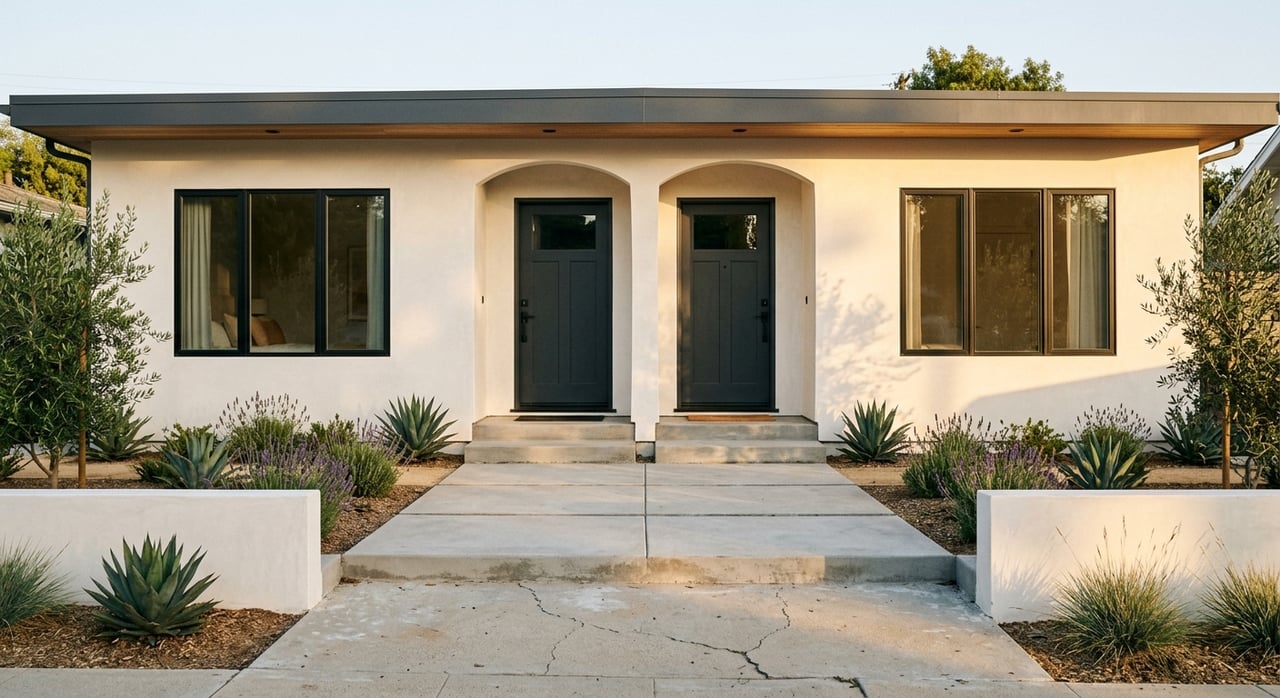
Thinking about a duplex or triplex in Anaheim but not sure if the numbers pencil? You are not alone. Prices are high, rents are solid, and today’s rates make cash flow tight. The good news is you can learn a simple way to underwrite small multi‑units so you make offers with confidence and avoid surprises later. In this guide, you will see the exact steps, key formulas, and two Anaheim‑based examples you can copy and adapt. Let’s dive in.
Anaheim small multi‑unit snapshot
Anaheim home values are in the low‑to‑mid $900k range, with recent market reports showing a median sale price around $918k to $923k. Small multi‑unit listings (2–4 units) commonly ask about $1.0M to $1.8M, with an active‑listing midpoint near $1.5M. Rents often fall in these ranges: 1‑bedrooms in the low‑to‑mid $2,000s, 2‑bedrooms around $2,600 to $2,800, and 3‑bedrooms roughly $3,500 to $4,000 depending on location and condition. Always check unit‑level comps for the exact neighborhood.
County market reports put stabilized multifamily cap rates in the mid‑4% range. You can review Orange County benchmarks in the Matthews Real Estate summary of late‑2025 trends, which supports those mid‑4% figures for stabilized assets in the area. See the Orange County multifamily report.
On the financing side, the Freddie Mac weekly survey pegged the average 30‑year fixed mortgage near 6.09% in early February 2026. Check the latest Freddie Mac PMMS when you underwrite.
How to run the numbers
Start with income
- Gross Scheduled Income (GSI): Add up monthly market rents for each unit, then annualize (× 12). Include modest other income like laundry or parking.
- Vacancy and credit loss: Use 3–7% for Orange County. A conservative starting point is 5%.
- Effective Gross Income (EGI): GSI minus vacancy plus any other income.
Estimate expenses
Plan for these common line items on 2–4 unit buildings in higher‑cost California markets:
- Property taxes: California’s Prop 13 base is about 1% of assessed value plus bonds/assessments. A quick Anaheim rule of thumb is about 1.1% to 1.25% of the purchase price for year one unless you know the exact tax rate area.
- Insurance: Many small buildings fall around $1,800 to $3,000 per year as a starting point. See an overview of landlord insurance costs.
- Property management: Full‑service management often runs 8% to 12% of collected rent for small properties. Read more on typical fee ranges.
- Repairs and reserves: Budget $1,000 to $3,000 per unit per year for routine work and minor capital items.
- Utilities you pay: Water, trash, landscaping, or common‑area electricity if not separately metered.
- Expense ratio: A quick check is 35% to 50% of EGI depending on age, metering, and management. If you are unsure, a conservative 40% is a fair placeholder.
Calculate returns
Use these core formulas to finish your underwriting:
- Net Operating Income (NOI) = EGI − operating expenses
- Cap rate = NOI ÷ purchase price
- Monthly mortgage payment (P&I) = (r × Loan) ÷ [1 − (1 + r)^(−n)] where r = monthly interest rate and n = number of payments
- Annual debt service = P&I × 12
- Cash flow before tax = NOI − annual debt service
- Cash‑on‑cash return = cash flow before tax ÷ cash invested at closing
- DSCR (Debt Service Coverage Ratio) = NOI ÷ annual debt service. Many lenders target 1.20 to 1.35 or higher on small income properties.
Example: Anaheim duplex pro forma
This is a worked example using realistic Anaheim prices and rents. Swap in the numbers for your target property and comps.
- Purchase price: $995,000
- Unit mix and market rents: 3BR at $3,500/mo; 1BR at $2,300/mo
Income
- GSI: ($3,500 + $2,300) × 12 = $69,600 per year
- Vacancy (5%): $3,480
- EGI: $69,600 − $3,480 = $66,120
- Add other income (laundry): $600 → EGI ≈ $66,720
Operating expenses (example)
- Property tax: 1.10% × $995,000 = $10,945 per year
- Insurance: $2,000 per year
- Owner‑paid utilities: $1,800 per year
- Property management: 8% × $66,720 = $5,338 per year
- Repairs and reserves: $3,000 per year
- Misc/legal/accounting: $1,200 per year
- Total operating expenses: ≈ $24,283 (about 36% of EGI)
Outputs
- NOI: $66,720 − $24,283 = $42,437 per year
- Cap rate: $42,437 ÷ $995,000 = 4.26% (consistent with mid‑4% OC markets)
Financing example (owner‑occupied conventional)
- Down payment: 20% = $199,000; loan = $796,000
- Rate/term: 30‑year fixed at 6.09% (PMMS reference)
- Monthly P&I: ≈ $4,818.58 → annual debt service ≈ $57,822.94
- Cash flow before tax: $42,437 − $57,822.94 = −$15,386 per year
- Cash invested: $199,000 down + ~2.5% closing costs ($24,875) + $5,000 reserves = $228,875
- Cash‑on‑cash: −$15,386 ÷ $228,875 ≈ −6.7%
- DSCR: $42,437 ÷ $57,822.94 ≈ 0.73
Reading the results
- At typical Anaheim prices and market rents, a leveraged duplex often produces a low cap rate and thin or negative cash flow at today’s rates. If you plan to house‑hack, model your out‑of‑pocket housing cost with one unit as your primary residence and the second unit offsetting your payment.
Example: Anaheim triplex pro forma
A second worked example using a common triplex price band and Anaheim‑level rents.
- Purchase price: $1,350,000
- Unit mix and market rents: Two 2BR units at $3,000/mo each; one 1BR at $2,250/mo
Income
- GSI: ($3,000 + $3,000 + $2,250) × 12 = $99,000 per year
- Vacancy (5%): $4,950
- EGI: ≈ $94,050
Operating expenses (example)
- Property tax: 1.10% × $1,350,000 = $14,850 per year
- Insurance: $3,000 per year
- Owner‑paid utilities: $2,400 per year
- Property management: 8% × $94,050 = $7,524 per year
- Repairs and reserves: $4,500 per year
- Misc/legal/accounting: $1,500 per year
- Total operating expenses: ≈ $33,774
Outputs
- NOI: $94,050 − $33,774 = $60,276 per year
- Cap rate: $60,276 ÷ $1,350,000 = 4.47% (in line with county mid‑4% benchmarks)
Financing example
- Down payment: 25% = $337,500; loan = $1,012,500
- Rate/term: 30‑year fixed at 6.09%
- Monthly P&I: ≈ $6,129.16 → annual debt service ≈ $73,549.90
- Cash flow before tax: $60,276 − $73,549.90 = −$13,273.90 per year
- Cash invested: $337,500 down + ~2.5% closing costs ($33,750) + $7,500 reserves = $378,750
- Cash‑on‑cash: −$13,273.90 ÷ $378,750 ≈ −3.5%
- DSCR: $60,276 ÷ $73,549.90 ≈ 0.82
Key takeaway
- Even with three units, many leveraged deals in Orange County will not cash flow at today’s rates unless you buy below ask, unlock higher sustainable rents, reduce expenses, or increase the down payment.
What the results mean in Anaheim
Anaheim is a strong long‑term rental market, but prices and rates compress near‑term yield. Here is how buyers often improve the numbers:
- Buy well: Negotiate price based on inspection findings or days on market.
- Finance smart: Shop lenders for lower points or rate buydowns, or consider owner‑occupied loan programs when you live in one unit.
- Increase income responsibly: Add laundry income, rent out parking where allowed, or make value‑add upgrades that support higher market rent.
- Manage expenses: Self‑manage early on, sub‑meter utilities if feasible, and schedule preventative maintenance.
- Add equity: A larger down payment can push DSCR above common lender thresholds and reduce monthly risk.
Financing paths for 2–4 units
- FHA owner‑occupied (1–4 units): As little as 3.5% down in many cases. For 3–4 units, FHA may require a self‑sufficiency test and reserves. Program rules change, so confirm details in the current FHA Handbook and with your lender. See FHA Handbook reference.
- Conventional (Fannie/Freddie): Owner‑occupied 2–4 unit options exist, often with lower down payments than investor loans. Check Orange County loan limits and lender overlays before you underwrite.
- Investor/portfolio or small‑commercial: Expect higher down payments, rates, and DSCR‑based underwriting. Many lenders look for DSCR between 1.20 and 1.35+ depending on the product.
Tenant laws and local notes
California’s Tenant Protection Act (AB 1482) sets a statewide rent cap of 5% plus regional CPI, up to a 10% maximum annually for most covered units, along with just‑cause eviction rules. Review notice timing rules for rent increases and verify whether your property is covered or exempt. Read an AB 1482 guide.
Security deposits changed under AB 12, effective July 1, 2024. For most rentals, the general limit is now one month’s rent, with narrow exceptions for small individual owners. Confirm the latest Civil Code language and any exceptions for your case. See the SF.gov summary.
Anaheim does not have a broad citywide rent‑control regime like some California cities, but you should still confirm business licensing, rental registration, and short‑term rental rules in the municipal code before you close.
Underwriting tips for Anaheim buyers
- Build two pro formas: A conservative version with 5–7% vacancy, a 40–45% expense ratio, and current rates; and an optimistic version with 3% vacancy, a 30–35% expense ratio, and modest rent growth.
- Include a capital reserve line every time: Roofs, HVAC, and water heaters are the most common surprises. Budget for them upfront.
- Get unit‑level rent comps: Citywide averages are a starting point. Verify rents by bedroom count, parking, in‑unit laundry, and recent renovations in the same sub‑area.
- Verify key documents early: Rent roll, leases, 12–24 months of operating statements, Schedule E from seller tax returns if available, utility bills, and a full property inspection.
- If you plan to house‑hack: Model your net housing cost with and without the rent credit. Owner‑occupied underwriting differs from investor DSCR lending, so align your plan with the right product.
Next steps
If you want help pricing an offer, refining a pro forma, or gathering local rent comps by unit type, tap a local advisor who lives this market day in and day out. With deep Anaheim roots and a track record across both home and small‑multi sales, Kevin Kott can help you underwrite clearly and negotiate with confidence.
FAQs
What cap rate should I expect on Anaheim duplexes and triplexes?
- County market reports show stabilized multifamily cap rates in the mid‑4% range, which aligns with the sample pro formas above for typical Anaheim pricing.
How do Anaheim property taxes affect my pro forma?
- A common first‑year estimate is 1.1% to 1.25% of the purchase price for taxes and assessments, with supplemental bills possible after close; confirm the exact tax rate area.
How much should I budget for management and insurance on small multis?
- Property management often runs 8% to 12% of collected rent and landlord insurance commonly ranges from about $1,800 to $3,000 per year for small buildings. See fee ranges and insurance cost context.
Can I buy a duplex or triplex with a low down payment?
- Yes, many owner‑occupants use FHA on 1–4 units with as little as 3.5% down, though 3–4 units may require a self‑sufficiency test and reserves; conventional owner‑occupied options also exist. Check FHA guidance.
What DSCR do lenders look for on small investment properties?
- Many investor and portfolio lenders target a DSCR of at least 1.20 to 1.35, but requirements vary by product, rate, and amortization.
How do AB 1482 and AB 12 impact my rental strategy in Anaheim?
- AB 1482 caps annual rent increases for most covered units at 5% plus CPI up to 10% and adds just‑cause rules; AB 12 sets most security deposits at one month’s rent. Review AB 1482 and AB 12 details.